
Self-determination Must Trump Colonial Borders in Africa
Qaanitah Hunter wrote in News24 this week that there is a new colonial assault on Africa’s sovereignty. This was in large part driven by Israel’s formal recognition of Somaliland as an independent state. She couldn’t have been more wrong when she declared Somaliland’s independence to be neo-colonialism and her argument fell apart when she boldly, but quite incorrectly, declared Israel’s recognition of Somaliland “a flagrant violation of international law”.
Anyone who has studied international law will confirm that, to its considerable discredit, it is far more about politics than it is about law. Academically, Somaliland is the most frequently used example that proves this point.
Contrary to Hunter’s fallacious claim, international law strongly affirms that all people have a right to self-determination. This appears in numerous legal texts, and the International Law Commission (ILC) lists self-determination as a peremptory right (jus cogens) of international law which no state may derogate, and which other states have an obligation to ensure other states respect (erga omnes).
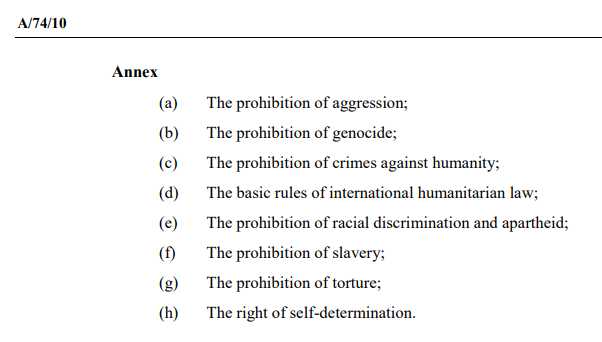
As an outspoken advocate of Palestinian self-determination, Hunter must surely be well aware of this reality, not least because South Africa has formally invoked its erga omnes obligations as the justification for its case against Israel at the International Court of Justice (ICJ) – albeit in the context of genocide rather than self-determination. Genocide appears on the ILC list alongside self-determination.
2001 Referendum
The people of Somaliland declared themselves independent in 1991. In 2001, they held a referendum on a new Constitution which affirmed Somaliland’s independence from Somalia. There was a 66% turnout, and 97% voted in favour of the Constitution and independence. Somalilanders have subsequently established a peaceful and functional democracy marked by independently verified elections and the peaceful handover of power following election losses. In contrast with war-torn Somalia, Somaliland has flourished under self-rule, creating a better life for its people.
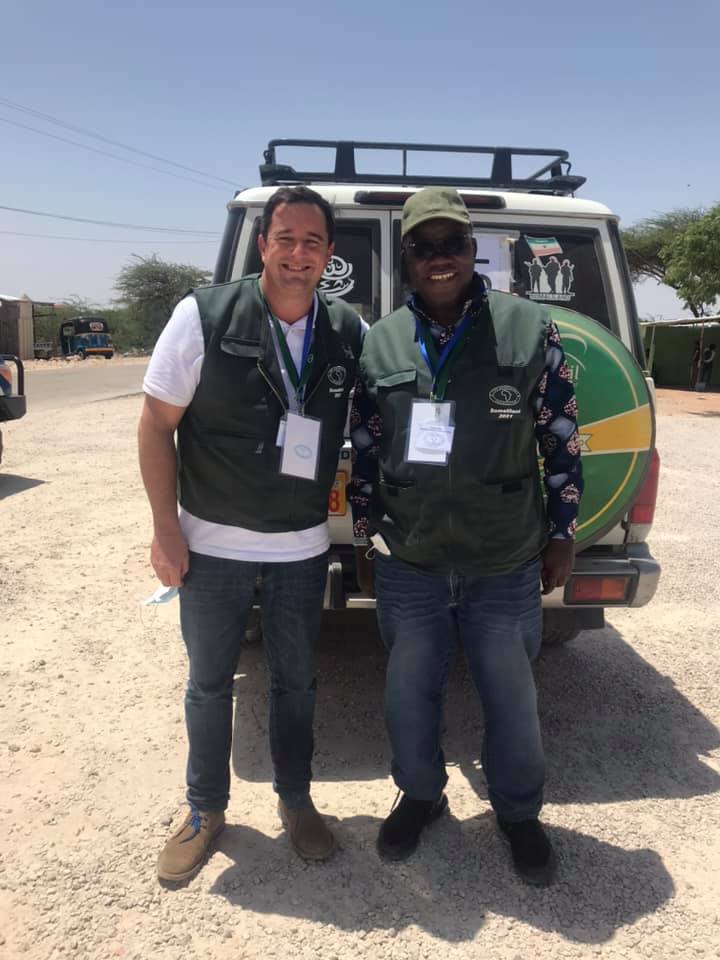
Somaliland ticks virtually every single box when it comes to the theoretical qualifying criteria for secession. It is already a highly functional independent state which has not been governed by Somalia for decades, and it is almost unanimously the democratic will of the people living there. What possible justification is there for denying Somaliland formal recognition of its already established independence?
The answer is that there is no legal or moral justification. Somaliland has been denied formal recognition because of the self-interest of the parties withholding it. The legal reality is that if anyone is contravening the spirit of international law, it is those who are failing to support the Somaliland people’s right to self-determination.
In her article, Hunter is a proxy for an extremely hypocritical school of political thought, and one which is shared by the South African Government. Their position is morally untenable.
They argue that Palestine has a right to self-determination, whilst endorsing organisations and states which assert that Israel does not. They support authoritarian regimes with appalling records of human rights like China, but they deny democratic Taiwan its right to self-determination. They support Western Sahara’s right to self-determination from Morocco, but deny the Western Cape people and Afrikaners the right to self-determination in South Africa.
Recent events, including Israel's recognition and the widespread regional condemnation it has received highlight how political self-interest often overrides principled support for self-determination.
Somaliland must not be allowed to become a pawn in the game of international politics. Instead, it should become a catalyst for genuine introspection, globally, but especially here in Africa.
Defending Colonial Borders
The real issue behind Somaliland is the concern that if Africa allows genuine self-determination, where will it end? This vryheid gevaar is captured in the African Union’s charter, which in Article 4(b) seeks to maintain colonial borders even when this results in the denial of self-determination, and is a result of the Organisation of African Unity (OAU, now the African Union) adoption, in 1964, of the principle of Uti Possidetis Juris (UPJ) – i.e. at independence, states will retain their colonial borders.
The reality is that the world, and even more significantly, the right to self-determination has moved on since 1964, and this principle is no longer compatible with at the very least the spirit of international law, and most likely its letter.
In Africa, Eritrea emerged as an independent state by restoring its pre-federation colonial borders, while South Sudan achieved independence through an agreed referendum respecting internal administrative lines from Sudan's 1956 independence – both exceptions to rigid application of post-1964 border sanctity – and in 2024, Ethiopia signalled its willingness to recognise Somaliland although it is under great pressure not to do so.
Notably, non-AU members like Israel and the US are not formally bound by the AU's internal principle of respecting historical colonial borders.
Hunter, and those who think like her, fail to realise that they are the ones quite literally defending colonialism in the form of borders drawn up at the Berlin Conference in 1884. If we are to respect the rights of all people equally, then self-determination is non-negotiable.
Ironically, in its own charter, the African Charter on Human and Peoples’ Rights, the AU sums this up better than in any other instrument of international law:
Article 20: All people shall have the right to existence. They shall have the unquestionable and inalienable right to self-determination. They shall freely determine their political status and shall pursue their economic and social development according to the policy they have freely chosen.
Somalilanders unequivocally made their choice in 2001. It is a choice that we must respect and support.


